Showing posts with label gardening. Show all posts

Thursday, June 11, 2015

Growing Organic Garlic


Edith on the farm

Please help me welcome Edith Maxwell to Killer Hobbies today!  I can't cook worth beans, but I love to eat, and garlic is one of my favorite food groups!  Today Edith will teach us how to grow our own.

Take it away, Edith!

 
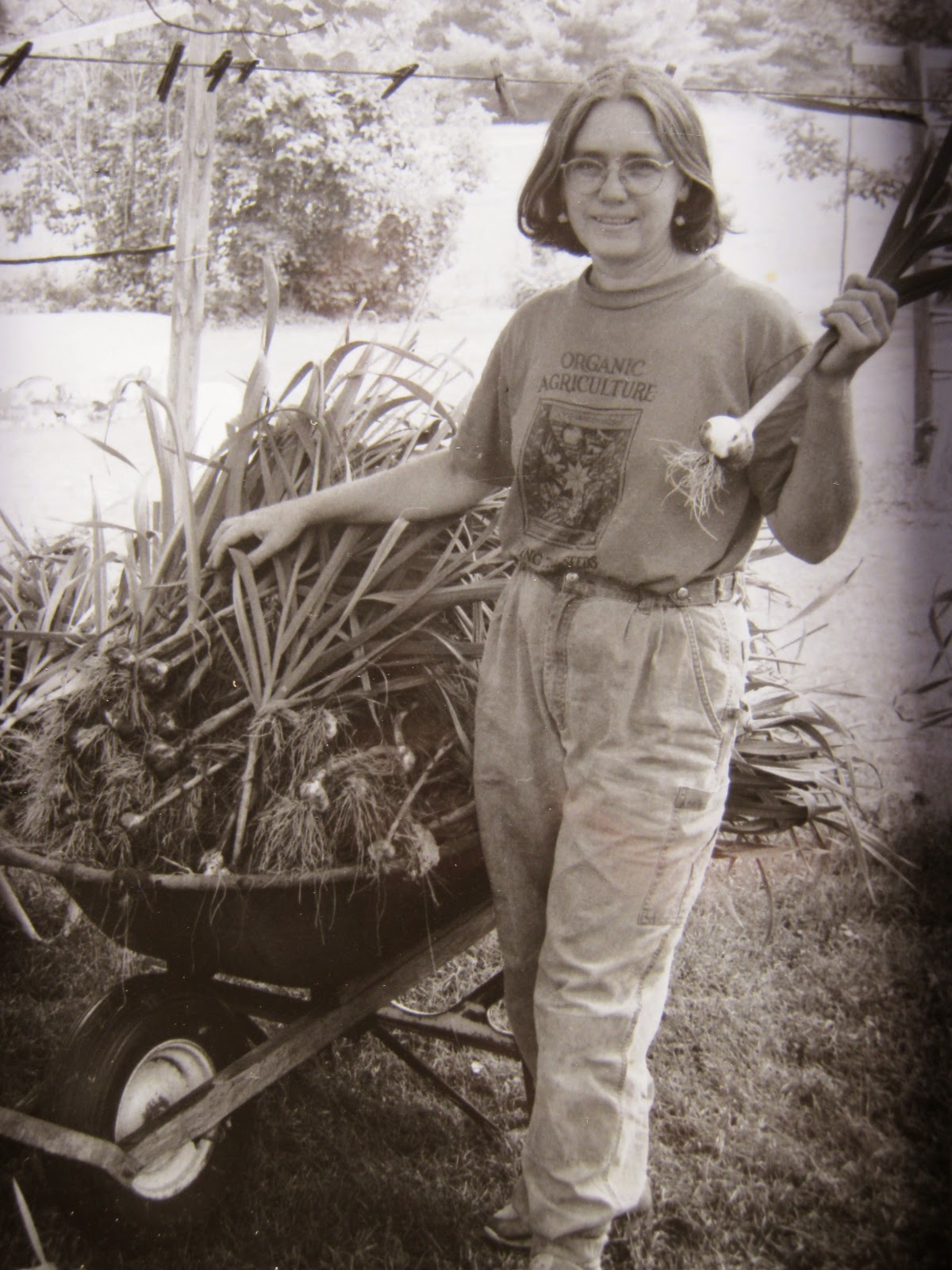
First, thanks so much for having me here as a guest, Tracy! Twenty years ago I operated and co-owned a small certified-organic farm in northeastern Massachusetts. One of my specialties was garlic. I grew hundreds of bulbs of both stiff-neck and soft-neck (braidable) garlic.
It’s a fabulous crop, and you don’t have be a farmer to grow it. In New England, farmers and hobby gardeners alike plant it in late fall, when everything else is dying off for the winter, preferably on a nice sunny Indian-Summer kind of day. Just get a few nice firm bulbs of organic garlic and separate them into cloves.
Here is a paragraph from my second Local Foods mystery, ‘Til Dirt Do Us Part, with organic farmer Cam Flaherty planting her garlic; it tells you how to plant the crop.  She has already split the bulbs into cloves, selecting the fattest ones for planting and using the rest in her own kitchen.
 
Kitty comes to investigate
 
 
Planting the bulbs
 
“She took the basket of cloves and a pitchfork to the field. She loosened a large bed that had held bush beans earlier in the season, so it was now rich in nitrogen from nodules on the legume roots, and covered it with several inches of finished compost. Kneeling, she pressed a clove, root side down, about an inch into the loose rich soil. The next clove went in four inches away. She continued that way along the length and width of the bed, every clove a hand’s width from its neighbor. Preston [Cam’s Norwegian Forest Cat] sidled by to visit and sat on a bale of salt marsh hay to watch her work.”
After the ground freezes in December, you mulch the beds with salt marsh hay, which prevents frost heaves. In April the green shoots push up through the hay, and you harvest it in late July. I learned much of what I know about growing garlic from a great book, titled Growing Great Garlic. Garlic has no pests in our area. It doesn’t need pruning or thinning. It feels like a free crop in the spring, because the work was done so long ago. I use lots of garlic when I cook, and it stores well. I can’t even think of a down side.

Garlic in April

 
Garlic in June
 
Scapes
When you plant stiff-neck garlic varieties like German Red and Rocambole, the cloves grow in a single layer around a central stalk. After the summer solstice, the garlic starts bulbing underground, and stiff-neck garlic throws up a scape. It’s the stalk, which becomes an alien-looking pointy growth that loops around into a circle and then keeps growing. The scape ultimately wants to become a garlic flower, but that robs the bulbs of energy, so you clip them off with scissors. Don’t compost them, though, because they’re delicious. I like to saute them. These crunchy green stalks, either whole or chopped, provide a nice mild garlic flavor. If you don’t grow your own, you might find some at a farmers’ market at the end of June.
I harvest the garlic when two-thirds of the leaves have yellowed, and lay it out first in the sun and then in a cool dry place to cure. Soft-neck garlic varieties, which grow in several concentric layers and don’t have the rigid central stalk, can then be braided.
Readers, what about you? Have you grown garlic? Do you have any varieties you prefer, or would you rather just shake a little dried garlic out of a jar?
In the third Local Foods mystery, Farmed and Dangerous (May, 2015), snow is piling up in Westbury, Massachusetts. Unfortunately murder seems to be the crop in season. Supplying fresh ingredients for a dinner at an assisted living facility seems like the least of Cam’s worries—until one of the elderly residents dies after eating some of her produce. As the suspects gather, a blizzard buries the scene of the crime under a blanket of snow, leaving Cam stranded in the dark with a killer who gives new meaning to the phrase “dead of winter.”
Agatha-nominated and Amazon-bestselling author Edith Maxwell writes four murder mystery series, most with recipes, as well as award-winning short stories.
Farmed and Dangerous is the latest in Maxwell's Local Foods Mysteries series (Kensington Publishing). The latest book in the Lauren Rousseau mysteries, under the pseudonym Tace Baker (Barking Rain Press), is Bluffing is Murder. Maxwell’s Country Store Mysteries, written as Maddie Day (also from Kensington), will debut with Flipped for Murder in November, 2015. Her Quaker Midwife Mysteries series features Quaker midwife Rose Carroll solving mysteries in 1888 Amesbury with John Greenleaf Whittier’s help, and will debut in March, 2016 with Delivering the Truth.
 
A fourth-generation Californian, Maxwell lives in an antique house north of Boston with her beau and three cats. She blogs every weekday with the other Wicked Cozy Authors (http://wickedcozyauthors.com), and you can find her at www.edithmaxwell.com, @edithmaxwell, on Pinterest and Instagram, and at www.facebook.com/EdithMaxwellAuthor.

Thursday, August 14, 2014

Don’t Worry, Be Hopi: Guest Post by Author Shannon Baker!

 
Hi all!  Please welcome my friend and fellow Midnight Inker Shannon Baker to Killer Hobbies today.  Take it away, Shannon!


I’ve been lucky to have lived in some pretty terrific places in the last ten years counting the Rocky Mountains and the Grand Canyon as my backyards. I am looking forward to setting down some deeper roots in 348 days when we plan to move to Tucson. But in the interim, we’ve taken up temporary residence in rural Nebraska. While I thought I’d escaped from here long ago, I have to admit to one thing that’s made the stay bearable.
I haven’t been able to plant a garden for several years, either because I lived in a townhouse without a yard or because I lived in Flagstaff where the growing season is five days and volcanic rock for soil. I’m particularly excited this year because after researching and writing about the Hopi tribe in Northern Arizona, I have a whole new appreciation for gardening.

Traditional Hopi culture is ancient and intricate. When Hopi emerged from the Third World to the Fourth, where we live now, they were given instructions from their Spiritual Guide (I won’t use his name here because a traditional Hopi friend asked me not to put it in print). Among other things, he told the people to live simply, practice self-denial and self-sufficiency. Along with telling them how to live, he gave each of about 30 clans a strict calendar of ceremonies and rituals and encouraged them to blend with the land and celebrate life.
The Guide gave Hopi responsibility to balance the entire world by maintaining the ceremonies and living according to His instructions. Hopiland is a microcosm of the world so what happens there will be intensified in the world. As it happens, young Hopi are leaving the reservation, decimating some clans, causing others to take up the slack. Climate change, severe weather disturbances, increased social conflict and cosmic dangers are the result of this lack, according to some Hopi traditionalists. This imbalance is telling us the Fourth World is nearing its end and with it, most of us will die.

But we don’t need to panic. Because the Guide predicted this state of affairs and He also gave the People a way to forestall or even halt disaster. There is a whole list of instructions that deal with living simply, being kind to each other and respecting Mother Earth. Of course, there’s more to it than what I’ve said but that’s for another day.

This summer, I’m interested in one particular instruction. He told us--all of us--not just Hopi, to:

PLANT THINGS

 
According to Hopi, the subsistence cycle contains four phases: planting, cultivating, harvesting and thanksgiving. This is the ceremonial cycle. For Hopi, farming is not just a chore, it’s sacred. Through the cycle, you grow ever closer to Mother Earth and the rest of creation.

We’re told to plant in good humor and to sing to the seeds, and later seedlings and plants and to harvest in thanksgiving. If we do all of this, the bounty of the garden is not counted in pounds of vegetables but in health and healing of the planet and mankind.

Those are pretty lofty ideals for my little backyard vegetable garden. I won’t admit to singing to my plants. I might just hum or whistle and sing a ditty under my breath, you know, as I do most of the time anyway. I don’t talk to them, either. Not any more than I talk to myself regularly.
Mostly, I’m excited to see them grow noticeably from early morning to evening. I’m trying not to be too alarmed by the summer squash, zucchini, and acorn squash who are overtaking everything and soon will start banging on my back door. So far we’ve enjoyed carrots, beans, beets, squash, peppers, more radishes than is prudent. The tomatoes are turning red ever so slowly but are so close!  

 
If I’m doing my part to save mankind, that’s a nice side effect.
Do you have any “instructions” on living for a more spiritual or environmental or happier existence?

Shannon

Shannon Baker writes the Nora Abbott Mystery Series, a fast-paced mix of murder, environmental issues and Hopi Indians published by Midnight Ink. A lover of western landscapes, Baker can often be found backpacking, skiing, kayaking, cycling, or just playing lizard in the desert.  Tainted Mountain, the first in the series is set in Flagstaff, AZ and is a New Mexico/Arizona Book Awards finalist. She serves on the board of Rocky Mountain Fiction Writers and is a member of SinC and MWA. Visit Shannon at www.Shannon-Baker.com.


Nora moves to Boulder and  lands a job as an accountant at an environmental non-profit. But the trust is rife with deceit and corruption. Nearly half a million dollars is missing and one person has already been killed for knowing too much. Complicating matters are Nora's uninvited visitors: her mother, Cole Huntsman, and a Hopi kachina that technically doesn't exist. As the body count climbs, Nora races to stop a deadly plot to decimate one of the planet's greatest natural resources.

Sunday, April 12, 2009

Pushing Up Daisies by Rosemary Harris


Today we welcome the third of our Agatha Award nominees for Best First Novel--Rosemary Harris.

Thanks so much Joanna and all the other Killer Hobbyists for inviting me to meet your readers. My first book, Pushing Up Daisies really did spring from my own hobby – gardening. Although I’ve always loved reading mysteries, I never dreamed I’d write one until one frigid February (much like this month in CT) when I saw a tiny item in the newspaper that read Mummified Body Identified. Ordinarily in February, I’d be outside pruning my azaleas, cutting back ornamental grasses and bringing in forsythia to force indoors. But that year we had 17 snowstorms in CT and gardening – while much on my mind – was months away. I had the time to do some research and I learned that the body that had been found hadn’t been 100% identified. I found myself thinking what most mystery writers think at some point – What if? What if they’re wrong?

’m convinced that if I’d read the article in June I’d never have written the book, but weaving (forgive me!) the story out of that one headline, and making my heroine a gardener was a way for me to be in the garden without freezing my keister off!

Apart from my own desire to be outside, it made perfect sense to make Paula Holliday a gardener. Every amateur sleuth has to have a job (unless you’re (Peter Wimsey) and as a gardener Paula can make her own hours, have lots of free time to solve crimes during the off-season, and she has a legitimate reason to be thrown together with lots of different types of people – from the day laborers she sometimes hires to the bluebloods whose gardens she works on. While I like to have Paula do some gardening in the books, they don’t include garden plans, and, although I am a master gardener, I hesitate to give gardening advice since every zone is different and every soil is different. That didn’t stop a woman from coming to one of my readings with a rotten tomato in a ziplock baggie. I was glad to learn that she wanted me to diagnose a problem and it wasn’t a reaction to the book!

Pushing Up Daisies has been a terrific experience for me – I know how lucky I’ve been! It was a Mystery Guild Selection, on Library Journal’s Best First Fiction List and now an Agatha Nomination. I’m over the moon! Book two in the series is The Big Dirt Nap, which just came out, and this month I’ll be delivering the manuscript for Deadhead, to be released in 2010. Thanks again for letting me chat about them here.
Cheers,
Rosemary

** Join us next week when our guest will be Krista Davis author of The Diva Runs Out of Thyme.
** Clue word: tomatoes
Remember--Submit all five "clue words" and I'll draw a name from the group on Monday, May 11. The winner will receive an autographed set of all five of the Agatha-nominated Best First Novels. That would be G.M. Malliet's Death of a Cozy Writer, "Sarah Atwell's" Through a Glass, Deadly, Rosemary Harris' Pushing Up Daisies, Krista Davis' The Diva Runs Out of Thyme, and Joanna Campbell Slan's Paper, Scissors, Death.

Saturday, June 23, 2007

Not-so-heavenly gardens, by Kathryn Lilley

Today’s topic is gardening.

It will come as no surprise to those of you who have read my previous posts that I am not the world’s most accomplished gardener.

But it’s not for lack of caring—or trying.

It’s not as if I have Kensington Gardens to maintain. My family and I live in Southern California, in one of those congested cities-by-the-sea, in a house that pushes up against the confines of its undersized lot. Instead of a garden, we are proud owners of a “decorative strip.” Our decorative strip is so narrow, it looks like it should get a bikini wax every week instead of a mowing.

But over the years, even the decorative strip has tested my mettle.

When we moved into this house five years ago, I was drawn to the giant trees that surround it. I didn’t realize that come fall, those trees would morph into leaf-dropping monsters. Their daily drop-off requires a raking-and-mop-up operation every twenty-four hours, at the very least. Which I don’t do, of course—I think that once-a-week raking is enough for any householder. And my husband’s response, whenever I mention the carpet of leaves, is always: “What leaves?” Bless his heart.

The worst thing about the leaves is that we’re the only house in the neighborhood with trees, except for the odd palm tree here and there. Our annual leaf carpet is painfully evident to all, like the neighbor who doesn’t mow the lawn all summer, or who keeps an old junker in the front yard.

One time at a block party someone asked me where we lived, and I said, “The house with the leaves.” This was met with a nod and an “Ah, yes.”

I haven’t had much success with planting things, either. Or with dealing with what’s already planted. We have a lovely pair of barrel-shaped shrubs, very tall, that provide a symmetrical balance to the southern side of the strip. But, they need to be trimmed. I once gave that task over to my husband (with a direct, please trim the shrubs request, so that there’d be no comeback of “what shrubs?”). He really seemed to take to the task, and I was happy—until I went outside and discovered that instead of two barrel-shaped shrubs, we now had shrub topiary. All of the branches in the lower halves had been whacked off, trimmed down to the bare trunk.

I shouldn’t complain. My idea of the perfect garden is one that you plant once, get just right--and then it stays perfect, forever more. That’s what I’ve heard they have in garden heaven. I keep trying to do weeding, but I get confused between the “real” plants and the weeds. I once pulled up a ring of daffodils—or maybe it was iris—thinking it was onion grass.

For the moment, I have retreated from the fray. A nice gentleman named Mannie now comes to our house every Wednesday morning. It takes Mannie fifteen minutes to do more than we ever accomplished in eight hours. And he does it twice as well.

I was thinking that the Mannie solution was just a stopgap, until I could recharge my gardening engines and give it another go.

But then I saw his results. And now, I’m not so sure. I believe that Mannie may be here to stay.

At least through the leafy-carpet season.

--Kathryn
http://www.kathrynlilley.com/