Showing posts with label plotting the mystery. Show all posts

Thursday, January 25, 2018

Back to the Beginning

On Friday, I came to a standstill on my work in progress. I was writing words, but the plot seemed to found a holding pattern and was going round and round instead of moving forward. I concluded the book was broke. The only way to move forward was to go backwards. One of the issues was the person I had designated as the killer was not the guilty party. Now, this didn't come as a surprise to me because out of the fourteen mystery/suspense stories I have written, I was never right. The real killer was always revealed by writing the story.

Usually, I'd make notes in the manuscript and continue writing until the draft was complete and then add any necessary clues and details. This time that method wasn't working. I was adding to the word count but I knew they were filler words. The problem I was having was the motive for the crime was a little different than I originally thought, the "heart" matter of it wasn't the same, and that changed the mood of the story.

The only way to move forward was to go back to the beginning and adjust the mood in some places, lighten it up some, deepen it in others, and add in more about one relationship that at first was complementary but now drove a part of the story. 

Saturday, July 21, 2012

Is This Any Way to Write a Book?


It's been said that authors are divided into two camps: Planners and Pantsers.

A planner outlines her book. A pantser works by the seat of her pants.

I do a bit of both. Right now, I'm 25,000 words into Kiki Lowenstein Book #6. When I proposed this book to my publisher, I had one idea of where it would start and how it would go. But after giving it more time to percolate, I decided that I needed to follow up on the last book before I could move ahead.

Right out of the gate, I could see Kiki and the impact the climax of READY, SCRAP, SHOOT had on her. I could tell she wasn't the same woman who was my protagonist at the start of the series. In the first few chapters, I wanted to show how the constellation of characters around her had also changed. So I did.

I knew where I wanted to go, what dangers were ahead, and where each character was in his/her life journey, but after 25,000 words, I needed to orchestrate what would happen to each person and when it would happen. I also needed to figure out  the clues and the resolutions that would provide satisfaction to my readers.

So I stepped away from my keyboard. On full-sized sheets of paper, I started flow charts, detailing each individual thread of the book, who was involved, what happened, and so on. When I finished, I had three major flow charts. I also wrote down the theme of this book, as all my books have a social theme. This one is bullying.

With that in mind, I reviewed the flow charts. Where did I need to emphasize the bullying? Where did I need to clearly delineate the bully and the victim?

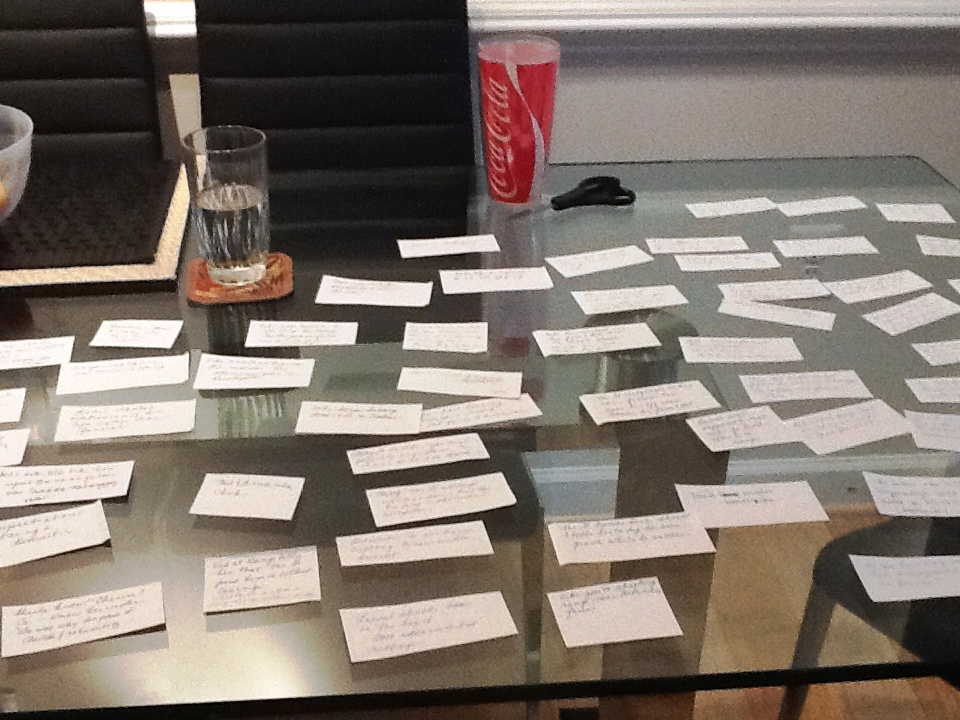
Next, I cut paper into narrow white strips. On these, I wrote snippets of scenes, comments, revelations to characters, and actions.

What you see above it all those small strips laid out on my dining room table. Once I had them all in front of me, I gathered them into days of action, working to sequence them logically--and also to swing the action from one character to another for variety. Now I have six stacks of slips. From these I'll write the rest of my book.

Any questions? Thoughts? How do the rest of you write if you do?

Sunday, June 6, 2010

What Makes a Musical Work? Or Not Work?


Often we authors and readers wonder what makes a book "work," or not "work." This weekend my husband and I were in New York City. We saw two musicals on Broadway, The Addams Family and Memphis. That generated a lot of discussion between David and me as we wondered why one “worked” and one didn’t.

Sad to say, The Addams Family stunk. The opening with the fabulous Addams Family theme--"They're creepy and they're kookie/Mysterious and spooky"--was actually the highpoint of the play as the we all sang along and snapped our fingers. Nathan Lane is a superb actor, an incredibly talented man with wonderful comic timing.

Why did The Addams Family stink? Here's what David and I came up with:

1. There was no internal logic to the show.
In one scene Morticia and Gomez wanted their daughter to be happy. But the Addams find “happiness” in misery. So which was it? Would they be happy if Wednesday was miserable? So, the "universe" that we were viewing was confusing!

2. The characters were inconsistent from their iconic selves. On the TV show, Morticia and Gomez loved each other so much that the world could fall apart around them and they wouldn't notice, which made for all sorts of complications. Not so in the play. When you are dealing with icons, it's best to stick to the originals or have a darn good reason for making changes!

3. There was nothing at stake and nothing significant changed. As a result, there was no real conflict. Here’s the plot: Wednesday Addams has fallen in love and wants to bring her boyfriend home to meet her parents. She wants Morticia and Gomez’s blessing…except that early on, she’s willing to run away without their blessing.

It gets worse. The boyfriend’s father connects with his inner macho-man through an encounter with a giant squid.

You read that right.

Not with Thing. Or Cousin Fester. Or Itt. But a Squid.

I can only imagine the desperation it must have taken to conjure up a giant squid to save a faltering plot. On second thought, I'd rather NOT think of the desperation it took.

By contrast, Memphis is the story of a white guy (Huey Calhoun) who falls in love with a young black singer, Felicia, who is singing at a bar owned by her brother. Huey wants to make Felicia a star, so he takes up the challenge of introducing black music (rock and roll) to the (white) world. But Felicia is convinced that Memphis will never accept him or be a big enough venue for her dreams.

Can you see all the inherent conflict? And the huge stakes? Trust me, it's a fabulous musical, one I'd love to see again! Of course, the music in Memphis was also just flat-out incredible.

I'm curious...if you have seen The Addams Family, what did you think of it? If you haven't, would might you expect? Did you enjoy the TV program? Have any of you seen Memphis? Doesn't the plot sound delicious?

Wednesday, August 27, 2008

Tombstones and Fairgrounds

Two events to report this week. First, last weekend Ellen and I went to Milwaukee to attend a Jewish service/ceremony called "Setting the Stone." It is a custom among some Jews not to put up a tombstone until a year has passed since a person’s death. Ellen and I had a friend named Sherwin Kader for many, many years – I used him as a character in my first published novel, Murder at the War, and used his real name (at his request) for a character in Ashes to Ashes. I knew him as Solly (for his SCA name of Solomon ben Jacob the Levite – he was very proud of his Jewish faith, can you tell?). Solly took up everything he did with passion. Not only was he a passionate Jew, he was a passionate member of the Robert Burns Society. So at the ceremony of the unveiling of his tombstone, not only his son the Rabbi spoke, so did the president of the Milwaukee chapter of the Robert Burns Society, an authentic Scot with a brogue so thick he was difficult to understand. It is also a custom when visiting a Jewish cemetery to put a small stone or pebble on the tombstone marking the grave of the person visited. There were a great many stones put on Solly’s marker, ranging in size from thumbnail to fist, a touching thing to see. We went back to his house after, where there was an awful lot of food waiting to be eaten, another Jewish custom -- but one shared by my Irish ancestors. The whole time Solly's spirit was so strongly present I could feel his strong arms around my shoulders and hear his powerful voice in my ears. We came back home on Sunday and I can still feel him near. The odd thing is, I wasn’t his closest friend, and I’m wondering if everyone who came is being haunted (in a warm, friendly, unnerving way) by Solly.

Second, I’ve made two trips to our State Fair, researching a short story I want to write for a new anthology from the editors who brought you Silence of the Loons and Resort to Murder. This will be called Murder on a Stick, and I want my short story to be called "It Slices, It Dices." I’m sure if you’ve ever been to a fair you’ve seen those booths with a man using a small knife to work miracles with fruit and vegetables. Making a palm tree out of a carrot and a green pepper, a rose from a radish, turning a potato into a pretty coil of circles. "Tell ya what I’m gonna do," he’ll say and make you a package offer of the potato peeler, the paring knife, the filet knife, and the hollow thing you stick into an orange to make it possible for your child to suck the juice out – and, of course, the CD to tell you how to do all those wonderful things with the Handy Dandy True Steel Eversharp Knife. He makes it look so easy! Part of the secret is the extreme sharpness of his blade. Which, naturally for a mystery author, turns her mind to murder. The interesting problem of murder at the Minnesota State Fair is, of course, what to do with the body? The place is crowded, fenced, and has few places locked against casual visitors. Even at night, when paying customers go home, there are police patrols, people taking care of the animals, and vendors straightening up for tomorrow. Well, I think I’ve found a place to dump a body, if my murderer can get it over there. It's a place everyone tends to stay away from or, if forced to visit, doesn’t look close or stay very long. Think about it: there are hundreds of cows, pigs, horses, sheep, llamas, chickens, ducks, turkeys, rabbits and God knows what other varieties of animals entered in competition for blue ribbons at the fair. They have to be fed and watered, and you know what happens to animal that’s been fed and watered. It was an interesting trip down among the animal barns, trying to find out where the effluent is put, and who takes it away, and how often. It was interesting to discover our fair is so big it has its own police department. It was interesting to find out how many booths offer knives, and who runs them, and how they have two barkers who switch off every hour. It will be interesting to see if I can get the doggone story done by the deadline of October 1.